Why are people protesting in Iran? Everything you need to know
Protests sparked by a widening economic crisis have swept across Iran for more than a week.
Demonstrations began in the capital, Tehran, on 28 December and have since spread to over 257 locations in 27 of Iran’s 31 provinces, according to the US-based Human Rights Activists News Agency (HRANA).
At least 29 people have died, two of which were members of Iran’s security forces, and more than 1,200 people have been detained, HRANA reported.
The protests do not appear to be slowing down and have the potential to be the biggest challenge clerical rulers have seen since the 1979 Islamic Revolution when former supreme leader Ayatollah Ruhollah Khomeini installed a Shia theocracy.
Here is what you need to know.
What caused the demonstrations?
Demonstrations began on 28 December when shopkeepers and bazaar merchants in Tehran staged a strike as the Iranian currency hit an all-time low against the US dollar.
Iran’s economy has been suffering for years and problems were exacerbated after Donald Trump reimposed US sanctions during his first term as president in 2018 and ended an international deal over the country’s nuclear programme.
Sanctions from the United Nations were also reimposed on the country in September 2025.
The country’s long-standing economic crisis deepened again after Israel and the US launched strikes on the Islamic Republic in June last year in a 12-day war that targeted several of Iran’s nuclear sites.
Iran maintains its nuclear energy programme is entirely peaceful and claimed it has not tried to build a nuclear bomb.
‘We are all caught up in this’
Problems with the economy has meant the nation has been struggling with an annual inflation rate of some 40%, with prices of essentials including cooking oil, meat, rice and cheese increasing beyond the means of most people.
“We are all caught up in this. I mean everyone,” Shirin, a 45-year-old housewife in the city of Kermanshah, told Sky News.
“A few days ago a tray of eggs were 280,000 tomans and now that has gone up to 500,000 tomans [approximately £9].”
She said the price of five kilograms of cooking oil had also jumped from 470,000 (approximately £11) to 1,200,000-1,400,000 tomans (approximately £25).
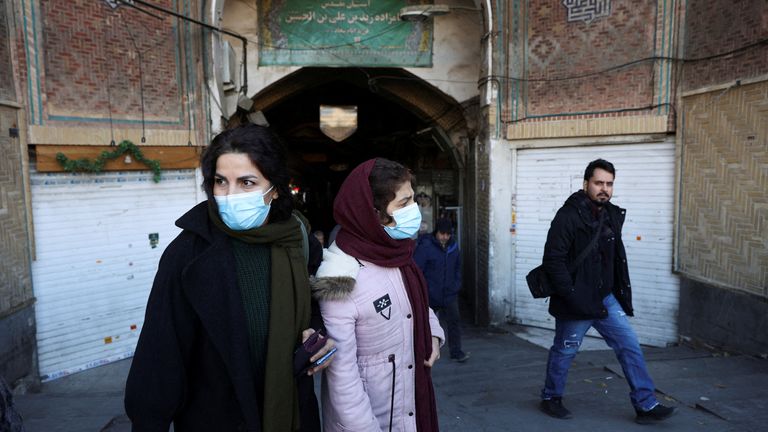
People walk past closed shops following protests. Pic: WANA/Reuters
It comes after Iranian President Masoud Pezeshkian announced his government will halt the process of providing a preferential subsidised rate of foreign currency to those who import goods.
Instead, the state will give a monthly subsidy to each person in Iran. By doing so, merchants are likely to hike the price of goods when the measure comes into force on 10 January.
Last year, the nation also introduced a new pricing tier for its nationally subsidised petrol, raising the price and putting further pressure on the population.
How widespread are the protests?
While protests initially focused on the economy, they have since focused on wider political issues, with protesters being heard chanting anti-government statements.
Footage from 30 December showed university students marching alongside shopkeepers and merchants in Tehran, chanting “rest in peace Reza Shah”, a reference to the founder of the royal dynasty ousted in the 1979 Islamic revolution.
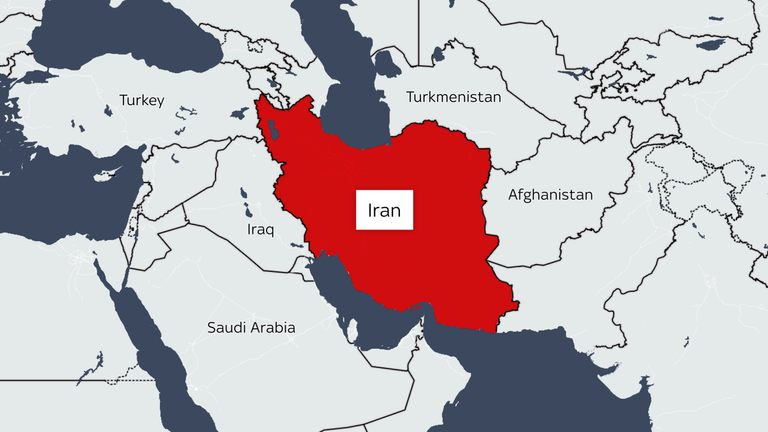
Protests have spread to over 257 locations in 27 of Iran’s 31 provinces
A day after, on 31 December, protesters attempted to storm a local government building in the southern Fars province, state media confirmed.
The Fars news agency, which is believed to be close to Iran’s paramilitary Revolutionary Guard, reported on 5 January that some 250 police officers and 45 members of the guard’s voluntary Basij force were hurt in the demonstrations.
It also alleged, without offering evidence, that demonstrators carried firearms and grenades.
The most intense clashes have been reported in western parts of Iran, but there have also been clashes between demonstrators and police in central areas, and in the southern Baluchestan province.
Demonstrators were filmed sitting down in front of security forces in Tehran’s Grand Bazaar market, while videos circulated online reportedly showing security forces in Malekshahi County in Iran’s Ilam province firing on civilians and raiding a hospital.
President Mr Pezeshkian later said he assigned the interior ministry to form a special team for a “full-fledged investigation” of what had been happening in the province, acknowledging the “incident in a hospital”.
Ilam province is mainly home to the country’s Kurdish and Lur ethnic groups and faces severe economic hardship.
On 5 January Kurdish opposition groups – considered the strongest opposition to the current regime – met and expressed full support for the protests and “uprisings against the Islamic Republic”.
The seven parties agreed to “intensify dialogue among Kurdish political forces” and “establish a roadmap to strengthen the political and national Kurdish movements in Iran”, which could indicate that protests may escalate further.
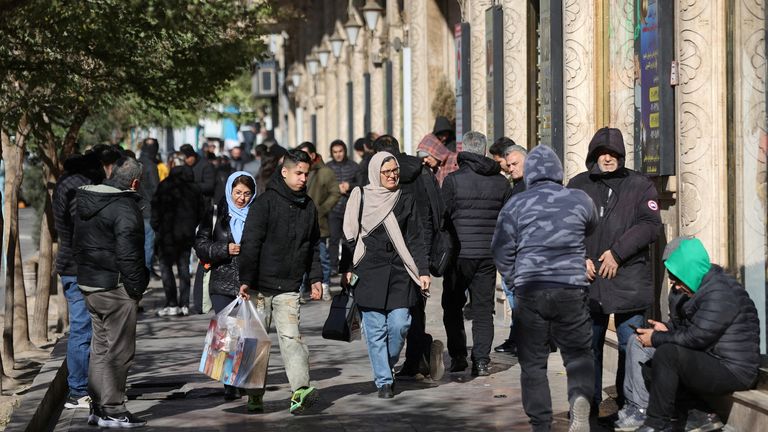
People walk past shops in Tehran. File pic
How is the US involved?
On 2 January, US president Mr Trump warned Iran via a post on social media that if Tehran “violently kills peaceful protesters,” the United States “will come to their rescue”.
“We are locked and loaded and ready to go”, the president said, without specifying what actions he was considering.
While it remains unclear how and if Mr Trump will intervene, his comments sparked an immediate, angry response, with Iranian officials threatening to target American troops in the Middle East.
Read more from Sky News:
Where could Trump strike next?
What it was like inside Maduro’s ‘dramatic’ court hearing
The comments took on new importance after the US military captured and extradited Venezuelan president Nicolas Maduro, a longtime ally of Tehran, to New York.
One Iranian official told Reuters that some authorities fear Iran could be “the next victim of Trump’s aggressive foreign policy”.
How has the Iranian government responded?
Shortly after protests began, Mr Pezeshkian said he had asked the interior minister to listen to the “legitimate demands” of the protesters.
The unusual response to unrest developed when the Iranian government offered to set up a dialogue with protest leaders on 30 December.
“We officially recognise the protests,” the government said. “We hear their voices and we know that this originates from natural pressure arising from the pressure on people’s livelihoods.”
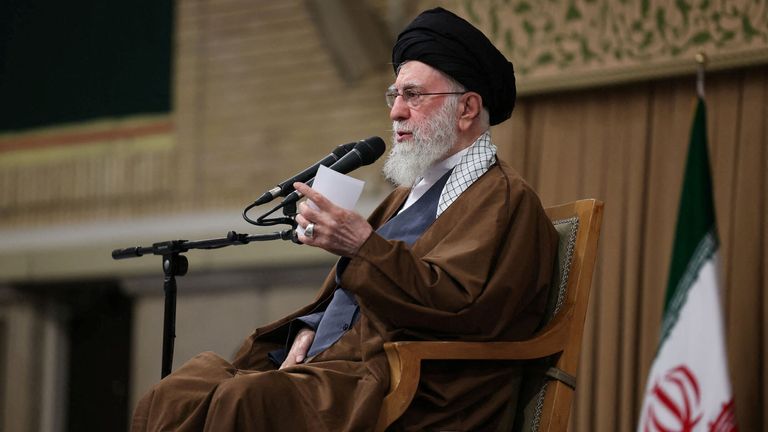
Iran’s Supreme Leader Ayatollah Ali Khamenei differentiated between rioters and protesters. Pic: WANA /Reuters
In his first comments on the disorder on 3 January, Supreme Leader Ayatollah Ali Khamenei sought to differentiate between protesters and rioters, saying the latter should be “should be put in their place”.
Ali Larijani, an advisor to Mr Khamenei, added that the Iranian government “consider the positions of the protesting merchants separate from those of the destructive elements”.
Addressing comments made by Mr Trump he added: “We and Trump should know that American interference in this internal issue is equivalent to chaos across the entire region and the destruction of American interests.”
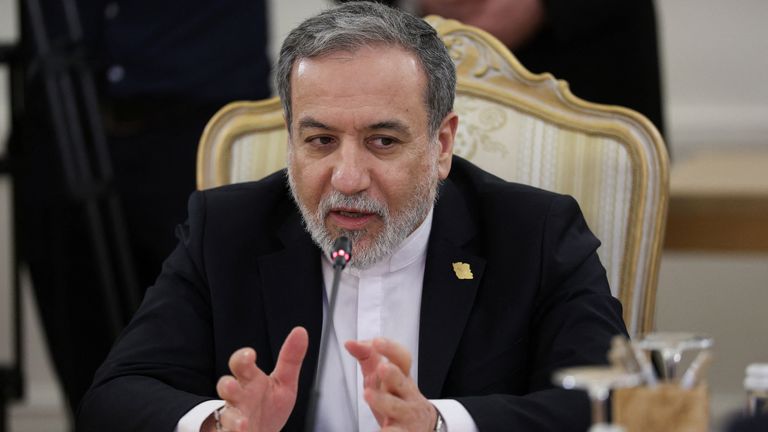
Iranian Foreign Minister Abbas Aragchi. Pic: Reuters
Has this happened before?
Protests in Iran are not unheard of, with protests occurring in the 1970s, 1990s and early 2000s.
More recently, Iran faced protests across the country in 2022 over price hikes, including for bread.
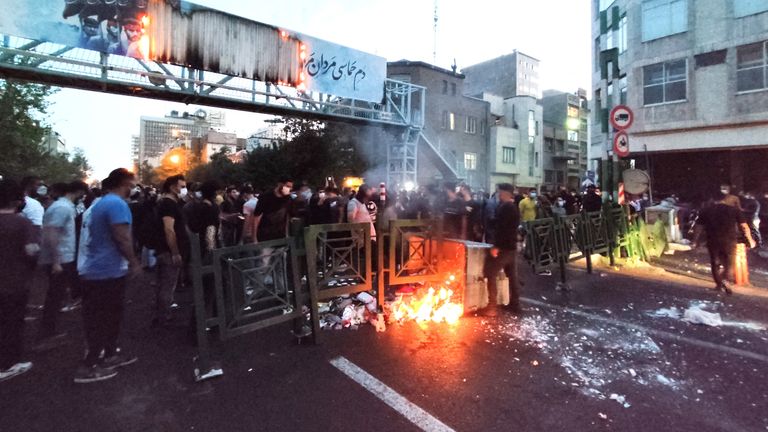
Protests in Tehran over the death of Mahsa Amini in 2022. Pic: WANA/Reuters
The country’s clerical rulers were rocked by the boldest unrest in years over the same period and into 2023 after the death of a 22-year-old Iranian Kurdish woman, Mahsa Amini, in the custody of the morality police, who enforce strict dress codes.
More than 500 people died in the months-long security crackdown and over 22,000 were detained.